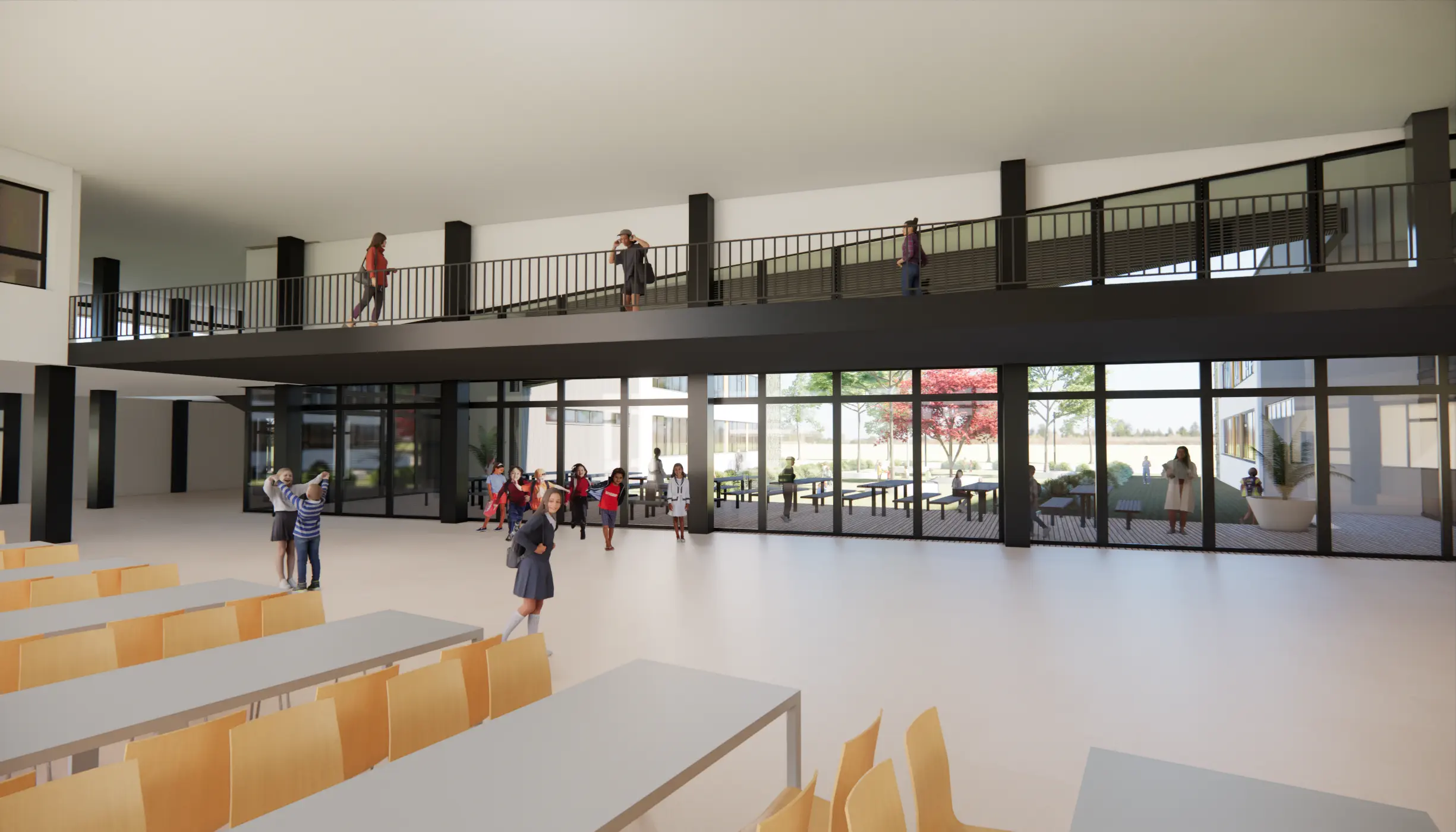
Primary School Rakarje/Pleso
SERVICES DELIVERED
Analysis of the existing capacities of all schools (baseline for sizing OŠ Pleso)
Concept proposal

ABOUT THE PROJECT
Primary School Rakarje/Pleso in Velika Gorica was designed as a new free-standing school with a three-section sports hall, outdoor facilities, and a heated connection (a pedestrian underpass) between the school and the hall.
The project was developed as one of the key interventions for introducing single-shift teaching and is sized for 24 classes (12 lower-grade and 12 upper-grade) plus an additional 4 special small-class units (PRO), to provide capacity for more inclusive models of education. The project was developed as one of the key interventions for introducing single-shift teaching and is sized for 24 classes (12 lower-grade and 12 upper-grade) plus an additional 4 special small-class units (PRO), to provide capacity for more inclusive models of education.
Within the concept design, three interconnected interventions are planned on the site: the school building, the three-section sports hall, and the pedestrian underpass, together with large, programmatically structured outdoor areas (a school square, school park, outdoor teaching spaces, and exercise areas).
The project was developed in line with the city’s development plans and applicable educational standards, with the intention that the school, the hall, and the outdoor spaces serve not only school needs but also the local community.


EU ALIGNMENT AND PROJECT LOGIC
The project’s EU logic is clear: it delivers demonstrable public value through single-shift operation and an all-day school model, with measurable capacities and inclusion as a real spatial decision. That is why the programme includes 4 special small-class units (PRO) from the outset, and why the school and sports hall are linked by a heated connection for safe, year-round use.
The project aligns with the NPOO call (NPOO C3.1.R1-I2.01), with a focus on sustainable construction (nZEB), green infrastructure and circularity, efficient water use, renewable energy, sustainable mobility and compliance with the DNSH principle.
Accessibility is treated as a binding requirement within the EU and national framework, embedded in circulation, entrances and the use of spaces for all users.